AI THEATER · A TRAGIC ENTERPRISE COMEDY
Steal this cartoon.
It's a gift — post it, share it, screenshot it. No attribution needed (though we never turn down a tag). Grab the format that fits your feed below.
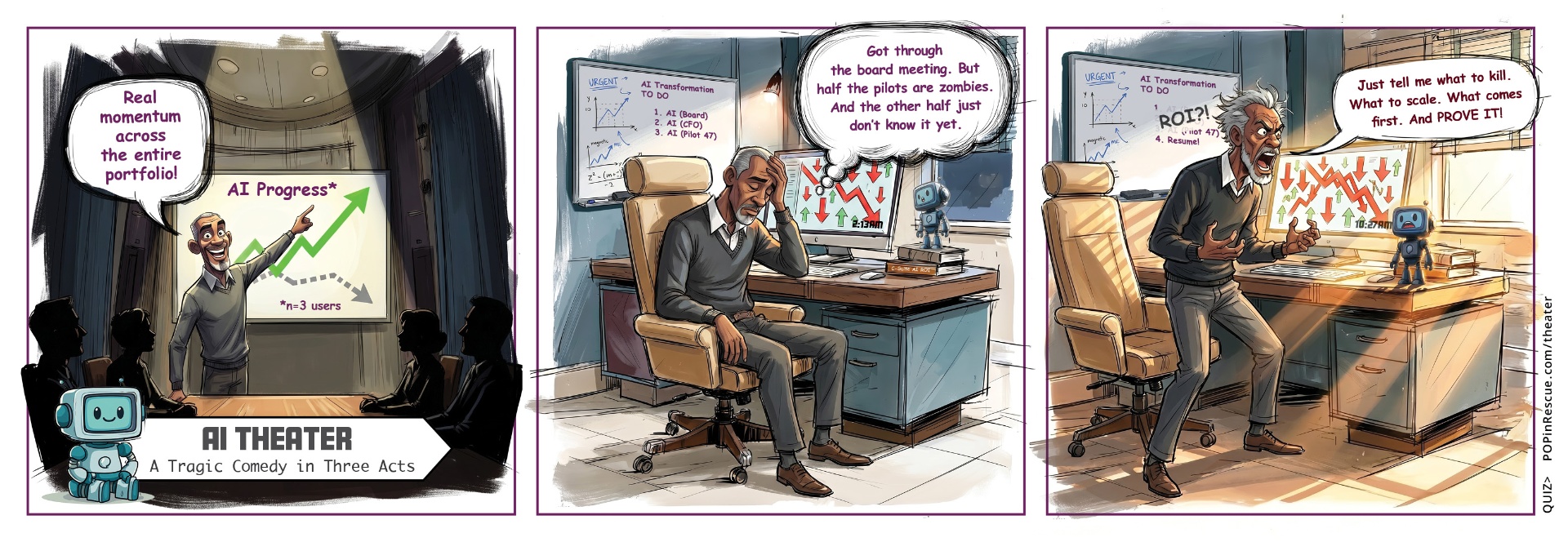
CARD 01 · THE TRANSFORMATION LEADER
The board sees "real momentum." The footnote says n=3. He knows. We all know.
Click to Download
Tip: Posting to LinkedIn? Drop the squares in as a carousel and let people swipe to the punchline.
Need a caption? Borrow one of ours.
Four angles, four tones. Copy whichever sounds like you.
"Real momentum across the entire portfolio. (Footnote: n=3 users.)"

That sounds about right for every AI transformation project I've seen.
Posting to LinkedIn? If you'd like to tag us, use @POPin and choose the teal speech bubble! LinkedIn ›
Article Prompts
Six takes your readers will actually read. Hit "Give Me the Prompt!" and we'll give you the prompt for your LLM to draft the article for LinkedIn.
You're quoting the "95% of AI fails" stat wrong.
MIT's number measures six-month P&L impact — mostly on sales-and-marketing pilots, the lowest-ROI corner of the study. The finding everyone skipped: vendor-led deployments succeed about 67% of the time; internal builds, roughly a third. The headline was real. The narrative wasn't.
97% say AI is working. 29% can prove it.
The widest gap in enterprise software right now isn't adoption — it's between the executives who feel a benefit and the ones who can show a number. How "we're benefiting" and "we have ROI" became two completely different sentences in 2026.
It's not a technology problem. It's an org-chart problem in a technology costume.
BCG pins roughly 70% of AI outcomes on people and process, not the models. Pilots don't die in the codebase — they die in the handoffs, the unclear ownership, and the meeting where everyone nods and no one decides.
The people who know which pilots are already dead have no safe way to say so.
Top-down mandates stall; the things that grow from the frontline stick. Why the truth is already sitting in your org — and why the status report is built to hide it.
Nobody kills the zombie pilot — because nobody owns the decision to.
Pilot purgatory isn't a budgeting failure, it's a decision-rights failure. Who is actually authorized to call kill, scale, or sequence? In most enterprises the honest answer is no one — so everything survives by default.
The AI question boards are about to start asking — and CIOs can't answer yet.
Abandonment is climbing (S&P Global: ~42% scrapped most initiatives last year) while spend keeps rising. "Prove it's working" is moving from the boardroom to the shareholder letter. The coming era of AI revenue accountability.
Wait — who's the little robot?
Look bottom-left of panel one. She's there the whole time, watching the performance. Nobody on stage notices her. That's the point.
Her name is POPpy, and she's the only one in the room who isn't performing. While everyone points at the chart going up, she's quietly reading the one going down. Which is, more or less, our job.
POPin tells leaders which AI initiatives to kill, which to scale, and which to sequence — with evidence that survives a board meeting. Less theater. More decision.
She's in every cartoon in this series. Once you spot her, you won't stop.

There's more where this came from.
Three more cartoons are in the pipeline, plus story angles we're glad to hand over. Reach out and we'll keep you stocked — or just trade AI-transformation war stories. Both make our day.
Take the Quiz Yourself!
The Diagnostic
Seven uncomfortable questions about your AI portfolio.
No consultants. No 90-slide maturity model. Just seven uncomfortable questions about whether your AI portfolio is producing progress, or performing it.