
Why 88% of AI Projects Fail to Scale — The Real Problem Isn't Technology
Despite billions invested, most AI initiatives never reach meaningful scale. The real barrier isn't technology — it's a systems challenge across people, processes, and technology.

Artificial intelligence has quickly become one of the most significant strategic investments organizations are making today. Companies across nearly every industry are launching AI pilots, hiring machine learning teams, and experimenting with new models and tools.
Yet despite the enthusiasm — and billions of dollars invested — most AI initiatives never reach meaningful scale.
Industry research consistently shows that as many as 80–88% of AI projects fail to reach production or deliver measurable business impact. Organizations successfully build prototypes and proofs of concept, but far fewer manage to operationalize AI across the enterprise.
Why does this happen?
The answer is often misunderstood.
Most organizations assume AI initiatives fail because of technology problems — the wrong model, poor data quality, or inadequate infrastructure.
But technology is rarely the real barrier.
AI transformation is a systems challenge involving people, processes, and technology — and organizations that focus only on the technology layer often overlook the more complex problems happening elsewhere.
The Three Dimensions of AI Transformation
Every AI initiative operates across three interconnected dimensions:
- People
- Process
- Technology
Technology is the most visible part of the system. It includes models, data pipelines, infrastructure, and tools.
But technology alone does not determine whether AI succeeds.
People determine whether AI solutions are trusted, adopted, and integrated into real decision-making.
Processes determine whether organizations can coordinate work across teams, move insights into operations, and scale successful initiatives.
When any of these three dimensions fall out of alignment, AI initiatives stall.
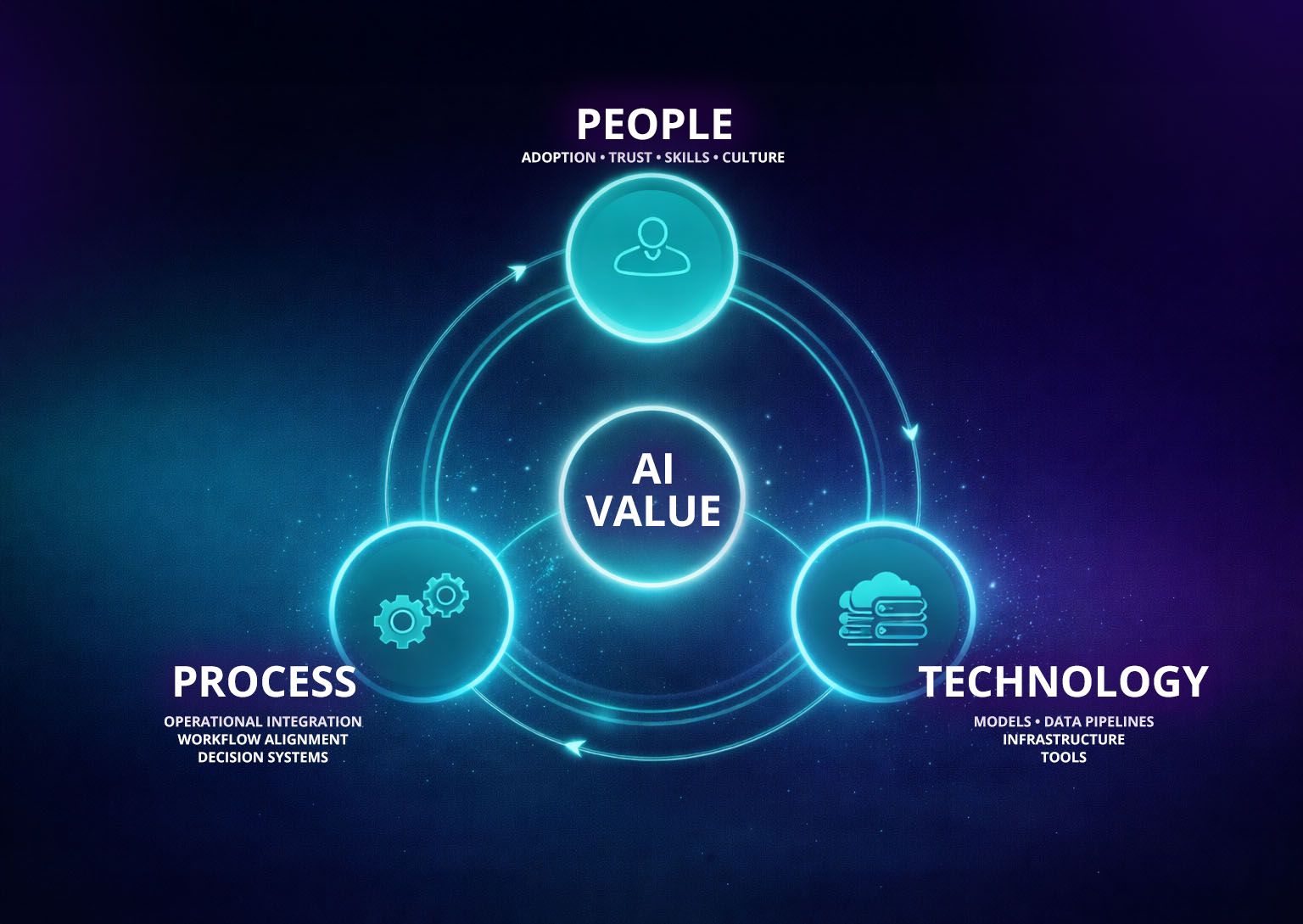
And in many organizations today, the people and process challenges are significantly harder than the technology challenges.
Why AI Projects Fail to Scale
Across industries, similar patterns appear when AI initiatives struggle.
1. Technology moves faster than organizational change
AI models can be built quickly, but organizations move more slowly. Business teams may not be prepared to integrate new capabilities into existing workflows.
2. Adoption gaps emerge
Even technically successful systems may fail if teams do not trust the outputs or understand how to incorporate them into daily work.
3. Processes cannot support scaling
Operational systems, governance models, and decision processes often lag behind AI experimentation.
4. Leadership lacks portfolio visibility
Executives often see individual projects but lack a clear view across the entire AI portfolio — making it difficult to identify emerging risks or stalled initiatives.
From a leadership perspective, the most dangerous aspect of AI transformation is that these problems often remain invisible until momentum has already been lost.
AI portfolios rarely fail dramatically.
They fail quietly.
The Portfolio Problem
These challenges point to a deeper issue.
AI transformation is not simply a collection of independent projects.
It is a portfolio management problem across people, processes, and technology.
Organizations must continuously evaluate:
- which initiatives are advancing
- which projects are stalled
- where coordination problems are emerging
- which experiments should scale across the enterprise
Without portfolio-level visibility, leaders cannot see how these signals interact — and therefore cannot intervene early enough to change outcomes.
From Data to Decision Intelligence
As AI adoption accelerates, a new category of platforms is emerging to address this challenge: decision intelligence platforms.
Rather than simply collecting metrics, these platforms analyze signals across people, processes, and technology to reveal where transformation efforts are succeeding or struggling.
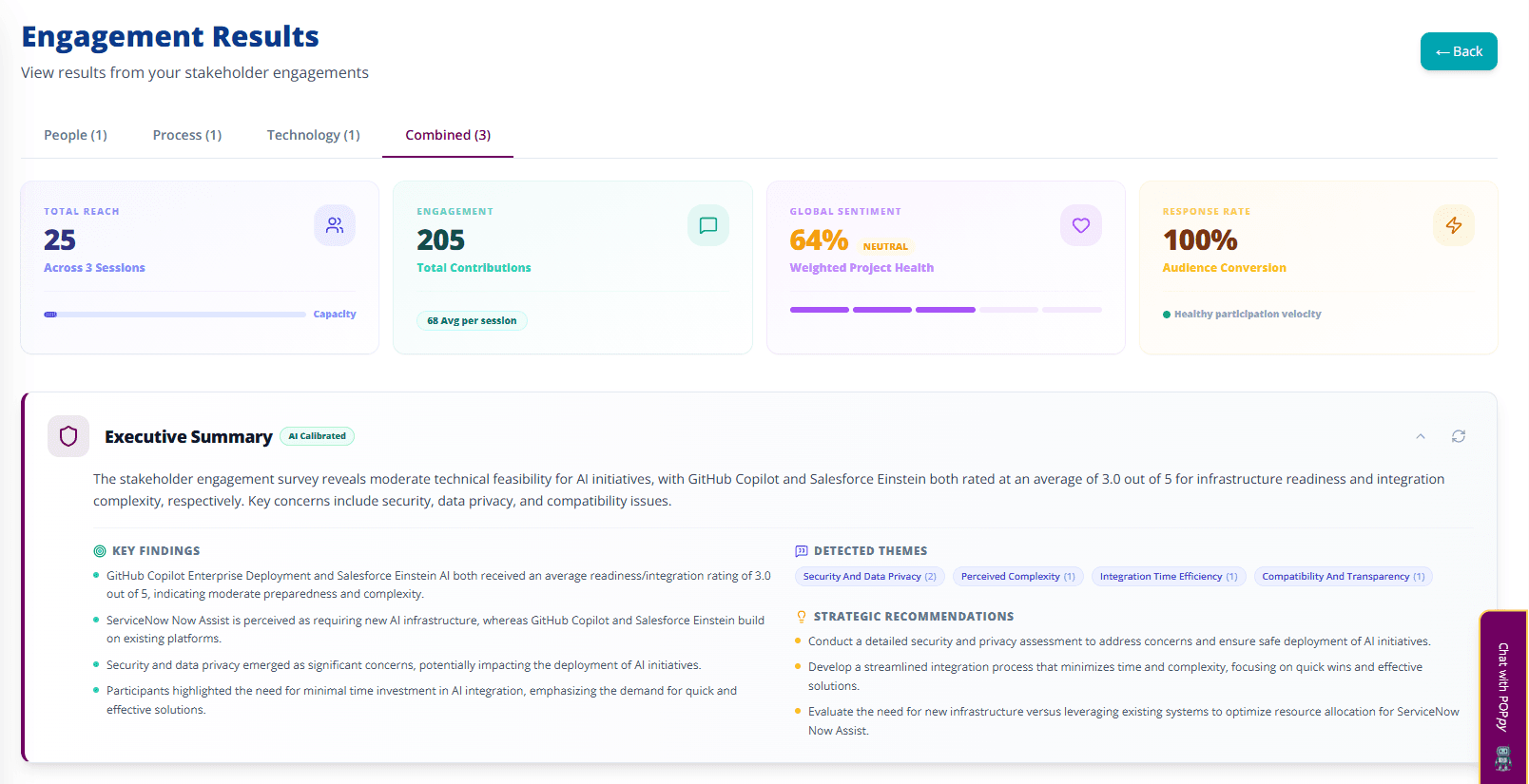
The goal is not more dashboards.
The goal is clear guidance on what leaders should do next.
Decision intelligence shifts the focus from:
"What happened?"
to
"What action should we take?"
A New Approach to AI Transformation
Organizations that successfully scale AI tend to take a different approach.
They treat AI transformation as an integrated system rather than a set of isolated technology experiments.
They invest in mechanisms that surface early signals across:
- People (alignment, adoption, engagement)
- Process (coordination, governance, operational flow)
- Technology (models, infrastructure, performance)
By combining visibility across these three dimensions, leaders can detect problems early and intervene before initiatives lose momentum.
The Future of Enterprise AI
As artificial intelligence becomes embedded in more core business functions, the complexity of managing AI portfolios will continue to grow.
Organizations that succeed will not simply have better models.
They will have better systems for understanding how people, processes, and technology interact.
The next phase of enterprise AI will not be defined solely by advances in technology.
It will be defined by better decisions.
Book a free 30-minute POPin First Look →