
The Real AI Crisis: Why Billions in Investment Are Producing Almost No Results
Despite enormous investment in artificial intelligence, most organizations are seeing little measurable return. A recent analysis highlighted that the problem is not the technology itself...
Executive Summary
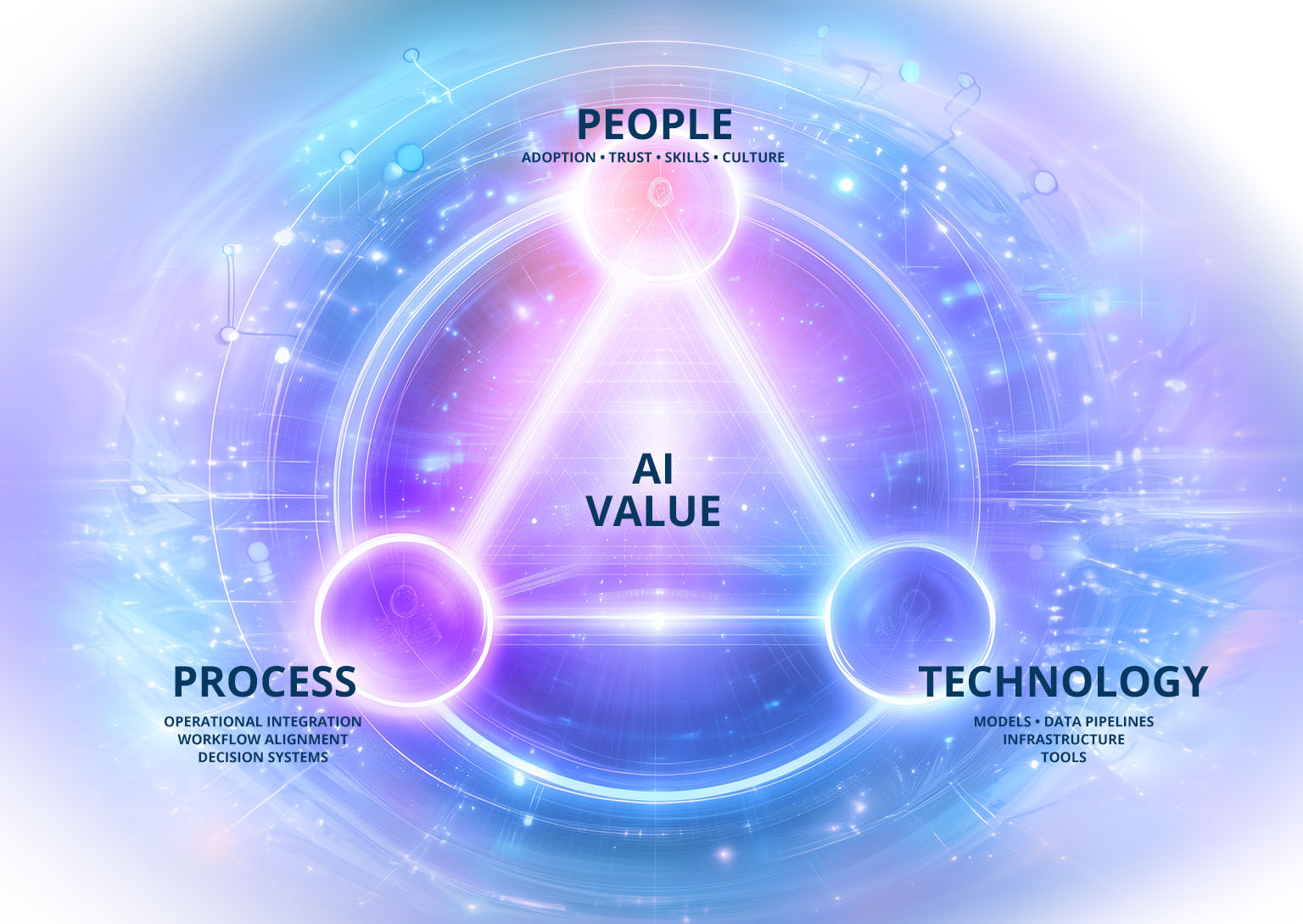
Despite enormous investment in artificial intelligence, most organizations are seeing little measurable return. A recent analysis highlighted that the problem is not the technology itself — modern AI systems are increasingly capable and widely available. Instead, the real barrier lies inside organizations: outdated workflows, incentives, leadership structures, and cultural resistance. Companies often deploy AI tools without changing how decisions are made or how employees work. As a result, AI becomes little more than an enhanced search tool rather than a transformative force. Organizations that succeed with AI focus not only on the technology but on restructuring processes, incentives, and leadership expectations around it.
Source Article
https://www.thestreet.com/technology/the-ai-problem-nobody-is-talking-about
Full Summary
Artificial intelligence is advancing rapidly and attracting massive investment across industries. Companies are spending billions to build AI capabilities, adopt generative tools, and integrate machine learning into their operations. Yet for many organizations, these investments are producing surprisingly little measurable impact.
According to research cited in the article, an MIT study found that 95% of organizations reported no meaningful return from their AI investments, despite spending tens of billions of dollars on enterprise AI initiatives. This paradox—massive investment but minimal results—reveals a deeper problem in how businesses approach AI adoption.
The core issue is not technological capability. Today’s AI models are powerful, widely accessible, and improving rapidly. The real barrier is organizational. Companies frequently treat AI adoption as a technical deployment rather than a transformation of how work actually gets done.
Many executives assume the process should look like a traditional software rollout: purchase the tools, install the systems, train employees, and expect productivity gains to follow. But AI does not operate like traditional software. It fundamentally alters how decisions are made, how teams collaborate, and how workflows operate.
Because of this mismatch, many AI initiatives stall. The technology is installed, but the organization does not change around it.
Experts point out that AI is ultimately adopted by people, not servers. Employees must integrate these tools into their daily decision-making processes. When organizational culture, management structures, and incentives remain unchanged, employees often default to familiar behaviors.
This leads to a common pattern across companies attempting to adopt AI. Employees may use generative AI tools occasionally—for writing emails, summarizing documents, or performing quick research—but the deeper workflows that determine business outcomes remain untouched. Strategic decisions, operational processes, and cross-team collaboration often continue exactly as they did before AI was introduced.
As a result, AI ends up functioning more like a “smarter search engine” rather than a system that reshapes how organizations operate.
The article highlights several structural reasons for this failure.
First, most organizations allocate resources primarily toward technology—new models, infrastructure, and software licenses—while neglecting the difficult work of changing workflows and culture. Technical teams are tasked with implementing AI, even though the most significant changes required are strategic and organizational.
Second, corporate incentive systems frequently conflict with AI insights. For example, a sales team may receive AI-generated forecasts that challenge traditional quotas or strategies. But if compensation and performance metrics are tied to the old systems, employees have little motivation to trust or adopt AI-driven recommendations.
Third, leadership often treats AI projects as experiments rather than organizational priorities. When early pilots fail to produce immediate results, companies abandon them instead of adjusting processes and continuing to refine the implementation.
In contrast, organizations that successfully realize value from AI take a different approach. Instead of focusing only on acquiring the most advanced models, they redesign how work happens around those tools.
Successful AI adoption requires:
rethinking decision-making structures
changing incentive systems
redefining leadership expectations
restructuring workflows to incorporate AI insights
In these organizations, AI is embedded into everyday operations rather than layered on top of existing systems.
The key lesson is that AI transformation is fundamentally an organizational challenge. Technology can provide powerful capabilities, but it cannot change a company’s culture, processes, or leadership priorities on its own.
Companies that treat AI as a simple technology upgrade will likely continue to see minimal returns. But organizations willing to rethink how decisions are made—and how people work alongside intelligent systems—have the potential to unlock the real value of artificial intelligence.
In other words, the biggest obstacle to AI success is not technical innovation. It is the human systems that surround it.
Book a free 30-minute POPin First Look →