
The Predictable Arc of a Gut-Feel AI Mandate
Most failed AI mandates die on the same timeline: a confident announcement, a green dashboard, a demo that stalls on the way to production, and a quiet retreat sixty days later that nobody schedules a meeting to announce. The pattern is predictable because nothing evidence-based was ever underneath it — and that's exactly why it can be broken.
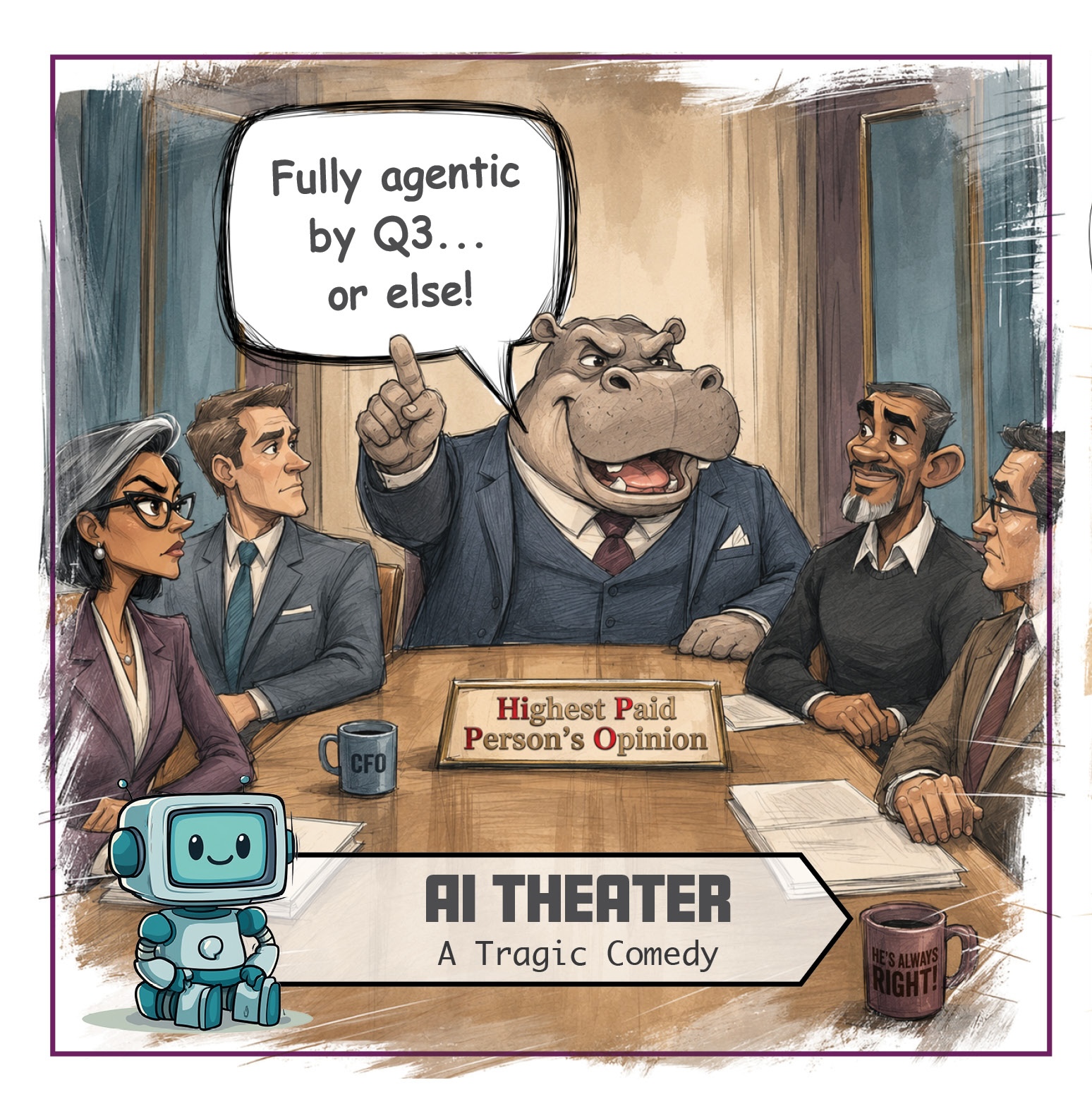
Every enterprise AI mandate that fails tends to fail the same way, on roughly the same timeline. That is the uncomfortable part for the executives who launch them. The technology is not what follows a script. The script is written by the decision to move without evidence, and the absence of evidence has a predictable half-life — usually somewhere around sixty days.
You have probably watched a version of it play out. You may have signed off on one.
Day one: the announcement. The AI mandate arrives with conviction and a launch date. A competitor shipped something, the board asked a pointed question, a keynote demo landed well, and now there is a directive to get generative AI into production this quarter. What is missing is the least exciting part of the sentence: a definition of what success looks like, who owns the number, and how you will know it is working before the budget is gone. Gartner's read on the current wave is blunt — most agentic AI projects are early-stage experiments "mostly driven by hype and often misapplied." Enthusiasm sets the timeline. Nobody sets the metric.
Week three: the reassuring dashboard. Something has to be shown upward, so a dashboard appears. It is green, because green is the color it was configured to display. Adoption charts tick up, usage is logged, and everyone in the review nods. The dashboard describes activity — logins, queries, tickets touched — and activity is not AI ROI. This is the phase where motion gets mistaken for progress, and where the people closest to the work, the ones who already know which pilot is alive on paper and dead in the building, have no safe channel to say so. It is the opening act of what we call AI Theater: the appearance of transformation standing in for the evidence of it.
Week six: the staged demo. The proof of concept performs beautifully in a controlled room with clean data and a friendly use case. Then it meets production — real permissions, real data quality, real workflow friction — and it stalls. This is the single most quantified failure point in enterprise AI. S&P Global Market Intelligence found in its 2025 enterprise survey that the average company scrapped 46% of its AI proofs of concept before they ever reached production. The demo was never the hard part. The journey from demo to daily operations is where AI initiatives go to die.
Day sixty: the quiet retreat. No one schedules a meeting to kill it. The initiative is folded into a platform team, quietly renamed, and left off the next deck. Budget gets reabsorbed. The narrative becomes "we're taking a more measured approach." S&P Global's 2025 survey put hard numbers on the retreat: 42% of companies abandoned most of their AI initiatives, up from 17% a year earlier. That is the most expensive silence in enterprise software — a category-level walk-away that rarely gets said out loud and almost never gets diagnosed honestly. The pilots that don't get retired outright slide into AI Purgatory, the quiet space where zombie projects survive audit after audit and careers stay staked on initiatives nobody is watching closely enough.
Why the arc is so predictable
Because nothing evidence-based was underneath the mandate to begin with.
The research on AI project failure is remarkably consistent, and it points away from the technology every time. BCG's 10-20-70 rule holds that 70% of the value in an AI transformation comes from people and process, and only 30% from algorithms and technology. MIT's NANDA project reported in 2025 that roughly 95% of enterprise generative AI pilots delivered no measurable P&L impact. When Gartner warned in June 2025 that more than 40% of agentic AI projects would be canceled by the end of 2027, it named three causes: escalating costs, unclear business value, and inadequate risk controls. Read that list again. Not one of them is a model problem. Every one is a scoping, ownership, and governance problem — the 70% the mandate skipped on day one in its rush to announce.
That is the real failure mechanism, and it is why buying a better model or switching vendors changes nothing. A more capable model pointed at an undefined outcome, with no owner and no controls, simply produces a more articulate failure.
Moving the evidence to the front
Breaking the arc means putting the evidence before the announcement instead of into the post-mortem. That is the entire premise of AI Portfolio Decision Intelligence: fusing the people, process, and technology signals across your portfolio into a single view, then turning that view into prescriptive intelligence about which initiatives to kill, which to scale, and which to sequence — with a defensible evidence trail behind every call.
It is the difference between managing an AI portfolio from status reports filtered through three layers of management and managing it from what is actually happening in the building. This is where POPin was built to operate: telling a transformation leader, in time to act, which projects to pursue, which to defer, and which to park, before the painful meeting six months after the window to fix it has closed. Prioritize the portfolio correctly, then keep prioritizing as it evolves. Optimize the initiatives worth pursuing before adoption resistance and integration risk turn into a budget overrun.
That capability is what separates an AI portfolio that compounds value from one that quietly drains budget and stalls careers. It is also what a CIO, CFO, or Chief Transformation Officer needs when the board stops asking "are we doing AI?" and starts asking "prove it's working."
The good news hiding in the failure data
The numbers land somewhere that is actually encouraging for any leader willing to hear it. A failure caused by the technology would leave you waiting on better models. This is not that. It is caused by launching an AI initiative on a hunch and expecting the evidence to catch up later. Evidence does not work that way. It has to be in the room on day one, or the sixty-day arc runs its course on schedule.
The leaders who win the AI decade will not be the ones with the most pilots or the flashiest demos. They will be the ones who refused to fly blind — who treated AI portfolio management as a discipline of evidence and decision rather than conviction and choreography. Machines optimize the path. Leaders still define the direction, and the decision intelligence you build now is the advantage that survives whatever AI becomes next.
So a question worth putting to your own leadership team this week: if someone asked which three AI initiatives in your portfolio are most likely to be quietly retired sixty days from now — could you name them, and could you prove it?
—
POPin helps leaders decide which AI initiatives to kill, scale, or sequence, with evidence that survives a board meeting. If your roadmap is running on someone's gut, that's the problem we built for. Take the 2-minute AI Theater quiz and see where your project ranks >
Book a free 30-minute Transformation Diagnostic →