
The Future of Enterprise Decision Intelligence
As organizations scale AI across departments, the real challenge is not generating more data — it is deciding what to do next. Enterprise decision intelligence is emerging as the critical capability for navigating large-scale AI transformation.
Enterprise decision-making is entering a new era.
As organizations adopt artificial intelligence across departments, products, and customer experiences, the complexity of leadership decisions is increasing dramatically. Executives are no longer evaluating a handful of technology initiatives — they are overseeing entire portfolios of AI experiments, pilots, and operational systems.
Every initiative produces signals.
Every team generates data.
Every system promises transformation.
But the real challenge for leaders is not generating more data.
It is deciding what to do next.
This is where enterprise decision intelligence is emerging as one of the most important capabilities for organizations navigating large-scale AI transformation.
The Complexity of Modern Enterprise Decisions
For decades, enterprise decision-making followed a relatively predictable structure.
Leaders gathered information from business units, analyzed performance metrics, and made strategic choices about investments and priorities. The systems supporting those decisions were mostly stable: ERP platforms, reporting dashboards, financial forecasts.
Artificial intelligence changes that equation.
Today's enterprises must evaluate signals from:
- Machine learning models
- Data pipelines and analytics systems
- Distributed engineering teams
- Product experiments and AI pilots
- Operational metrics across multiple departments
Each signal can indicate opportunity, risk, or failure.
The result is a new environment where leaders must manage an evolving portfolio of AI initiatives, each moving at a different speed and maturity level.
Without the right systems in place, the complexity quickly becomes overwhelming.
The Hidden Problem in AI Transformation
Most organizations assume that the primary challenge of AI transformation is technology.
They focus on:
- building better models
- acquiring more data
- expanding infrastructure
- deploying new tools
Technology is certainly important.
But in practice, most AI initiatives do not fail because the technology doesn't work.
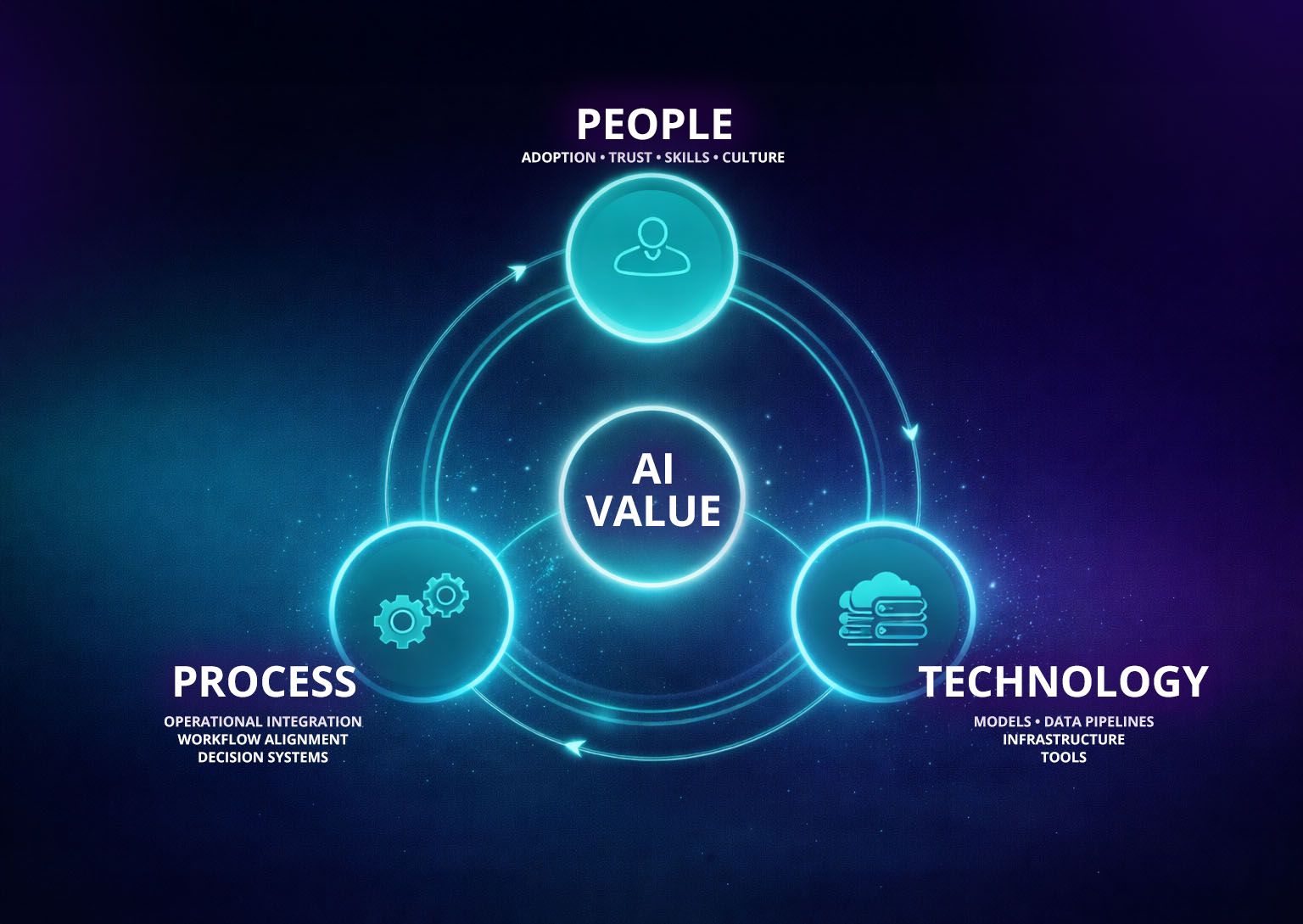
They stall because of misalignment across people, process, and technology.
Teams struggle to adopt new tools.
Processes cannot integrate AI insights into operational workflows.
Leadership lacks clear signals about which initiatives are succeeding and which are drifting.
When these three dimensions fall out of alignment, AI programs quietly lose momentum.
This is why so many enterprises report strong experimentation with AI but limited scaled outcomes.
From Data Overload to Decision Intelligence
The next phase of enterprise AI maturity is not about collecting more signals.
It is about turning signals into decisions.
Decision intelligence platforms help leaders understand:
- which initiatives deserve more investment
- which programs require intervention
- where adoption barriers are forming
- which efforts are delivering measurable outcomes
Instead of simply presenting dashboards or reports, decision intelligence systems help organizations move from observation to action.
This shift is critical for managing AI portfolios effectively.
When executives can see early indicators of success or failure across initiatives, they can intervene before problems escalate.
Managing AI as a Portfolio
One of the most important changes in enterprise AI strategy is the move toward portfolio management.
Organizations rarely deploy a single AI initiative. They deploy dozens.
Examples include:
- internal automation tools
- customer-facing AI features
- predictive analytics systems
- decision-support models
- operational optimization programs
Each initiative has different risks, adoption patterns, and operational challenges.
Treating AI initiatives as a portfolio allows leaders to balance experimentation with measurable outcomes.
But portfolio management requires visibility.
Leaders need to understand not only technical performance but also how initiatives are performing across the broader enterprise system.
This includes signals about:
- team adoption
- operational integration
- process readiness
- decision impact
Without that visibility, leaders are forced to rely on fragmented updates and anecdotal progress reports.
The Role of Prescriptive Intelligence
Traditional analytics platforms tell leaders what has happened.
Decision intelligence platforms go further.
They help leaders determine what actions should happen next.
Prescriptive intelligence systems analyze signals across people, processes, and technology to recommend interventions such as:
- reallocating resources across initiatives
- strengthening adoption in specific teams
- accelerating high-performing programs
- pausing initiatives that are drifting
This approach transforms AI oversight from reactive reporting into proactive leadership.
Instead of discovering problems months after they occur, organizations can detect early signals and respond quickly.
Why Decision Intelligence Will Define the Next Phase of AI
As AI becomes embedded across enterprise operations, leadership decisions will increasingly rely on systems capable of synthesizing large volumes of signals.
Decision intelligence provides that capability.
Rather than forcing leaders to interpret scattered dashboards and reports, these platforms provide a coordinated view of AI initiatives across the organization.
The result is greater clarity, faster intervention, and stronger alignment across the enterprise.
Organizations that build this capability early will gain a significant advantage.
They will not only deploy AI faster — they will manage AI more effectively.
The Future of Enterprise Leadership
In the coming decade, the most successful organizations will not simply adopt artificial intelligence.
They will develop the systems required to guide it.
Enterprise leaders will increasingly rely on decision intelligence platforms to manage complex AI portfolios, detect emerging risks, and prioritize the initiatives that create real value.
The goal is not more dashboards.
It is better decisions.
Because in a world where AI is everywhere, the organizations that win will be the ones that know exactly which decisions to make next.
Book a free 30-minute Transformation Diagnostic →