
The Executive View Problem: How Enterprise AI Programs Hide Their Own Failure
AI portfolios are failing not because the technology is bad, but because executives don't have the right tools to measure and manage the business value elements.
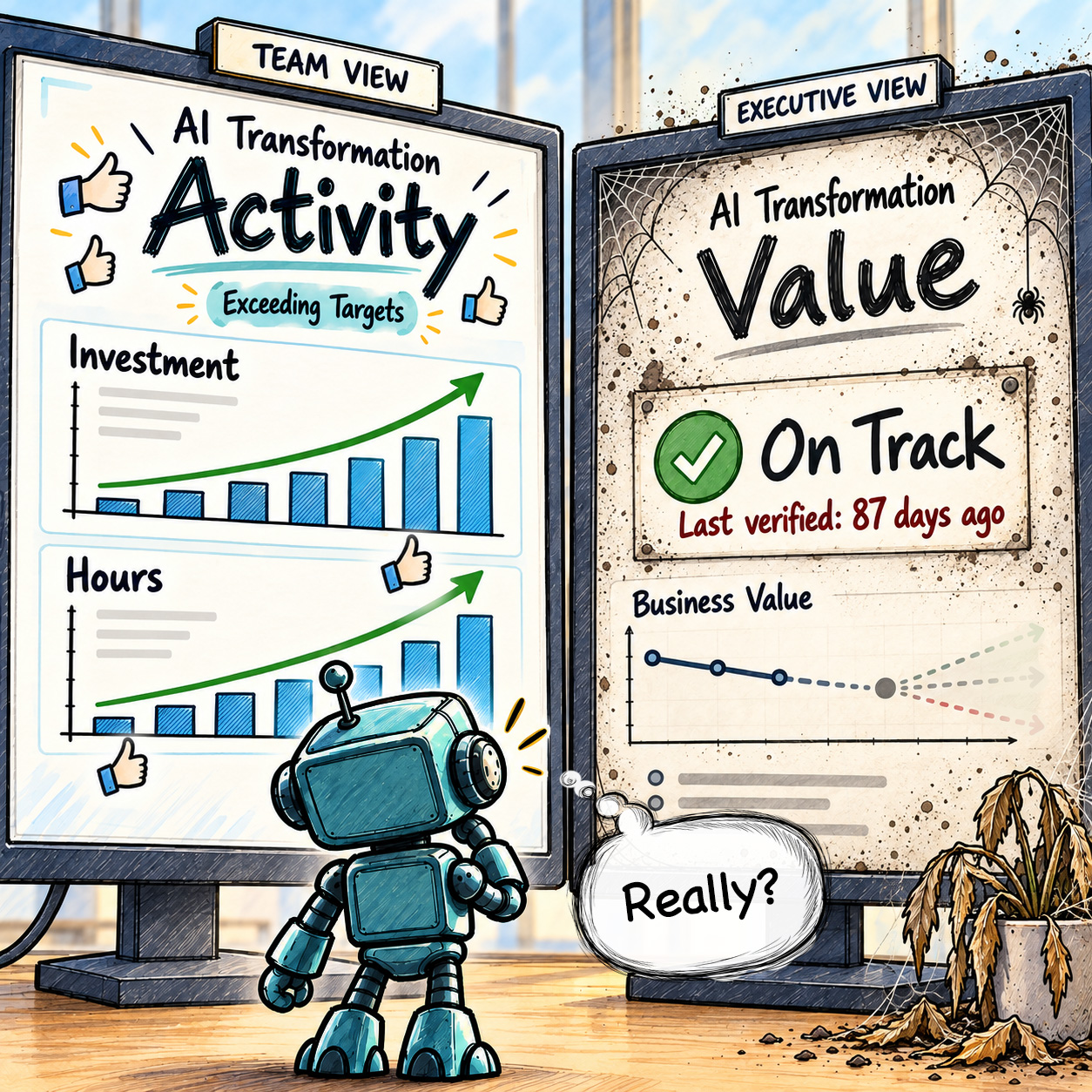
By the time an executive asks “is this working?” about an enterprise AI initiative, the answer has often been “no” for months. The pilot hit its milestones. The team is executing. The dashboards are green. And the business value — the actual reason the program was funded — has been drifting sideways, or down, since the second quarter after launch.
This gap, between what a program looks like it’s doing and what it’s actually producing, is what we call the Executive View Problem. It is the single most expensive pattern we see in enterprise AI portfolios today, and it is the pattern underneath nearly every “AI isn’t delivering ROI” headline, including the Apollo chief economist’s widely-circulated chart showing AI’s net economic payoff at approximately zero.
Apollo’s chart is accurate. It is also, we would argue, measuring the wrong level of the problem. The failure isn’t that AI doesn’t work. The failure is that enterprises can’t tell whether their AI is working, because the information systems they use to measure it were never designed to answer that question.
The anatomy of the gap
Walk into any enterprise AI steering committee this quarter and ask to see the program dashboard. You will almost always see something like this: investment levels tracked and reported, hours logged against initiatives tracked and reported, project milestones green, activity against plan at or above target.
This is the team view. It is accurate. It is up to date. And it is almost entirely disconnected from the business metric the initiative was funded to improve.
Now ask the same room to show you the executive view — the dollar outcomes the CFO or board was promised when the initiative was approved. In our experience, one of three things happens. The slide exists, but it says “On Track” with a last-verified date more than sixty days in the past. The slide exists, but it shows an activity proxy (adoption, usage, hours saved) rather than the business metric that was promised. Or the slide doesn’t exist at all, because nobody built a measurement system for the outcome before the project started.
In all three cases, the leadership team funding the program cannot see what the program is actually producing. They can only see that work is being done.
Why this pattern produces “zero payoff”
The macroeconomic consequence of this gap, aggregated across hundreds of enterprises, is exactly the pattern Apollo documented: significant investment, significant activity, no measurable return.
At the level of any individual enterprise, the consequence is more specific. Every quarter, executives are asked to re-fund programs they cannot evaluate. In the absence of clear outcome data, they default to the lowest-risk decision available, which is almost always “one more quarter.” Over four or five renewal cycles, portfolios accumulate initiatives that nobody is willing to kill, because the evidence to kill them was never gathered.
We call this condition AI Purgatory: the state in which no AI initiative is clearly succeeding, none is clearly failing, and all of them continue to burn budget. AI Purgatory is not an AI problem. It is a decision problem produced by an information gap.
What makes an executive view
An executive view, in the sense we mean it, has three properties that a team view does not.
It measures value, not activity. The question answered by an executive view is “what business outcome has this program produced since the last review?” If the answer is unclear, the view fails.
It carries a last-verified date. Every claim on the view — “on track,” “ahead of plan,” “generating $X in annualized value” — carries a date. If the date is more than ninety days old, the claim is treated as unverified. Unverified claims cannot be used to justify renewal.
It is sortable into decisions. An executive view is useful to the degree that it supports kill, scale, and sequence decisions at the next renewal cycle. If the view does not change what gets funded next quarter, it is not an executive view. It is a status report.
The 87-days-ago problem
The specific failure mode we see most often is what we have started calling the 87-days-ago problem. A program’s last-verified date — the last time a human actually confirmed its value — is roughly a quarter in the past. In that time, the team has continued to execute, the dashboards have continued to show green, and the business metric the program was funded to move has drifted somewhere nobody is looking.
By the time the next budget review arrives, the executive has two options: approve the renewal based on activity data they do not fully understand, or kill a program whose value they cannot measure. Nearly all choose the first.
That is how AI Purgatory grows. One quarter at a time.
Three questions a CTO can answer this quarter
If this pattern feels familiar, three questions are worth answering before the next budget review.
Does every AI initiative in your portfolio have a last-verified date on its executive view? If not, you do not have an executive view. You have a team view that has been given to executives.
Can you name the three business outcomes that would justify renewing each initiative? If you cannot name three, the initiative is being renewed on inertia, which is a form of AI Purgatory.
If someone else would do the paperwork, which three initiatives would you kill today? Those are your kill candidates. The reason they have not been killed is rarely that the evidence is unclear. It is that killing them is politically expensive. That is where the leadership work is.
What this is actually about
The companies that will show up on the next round of Apollo charts with a different number will not get there by building more AI. They will get there by building the information systems that make the AI they have already built legible to the people funding it, so that programs with real value can scale and programs without it can be killed before the next renewal.
Zero payoff is what happens when nobody owns the kill decision. Whoever owns the renewal cycle owns the number.
If you want help pressure-testing your AI portfolio before the next review, POPin’s Transformation Diagnostic takes about 20 minutes and produces a sortable view of what to Pursue, Defer, and Park across your initiatives. It’s free >
Book a free 30-minute Transformation Diagnostic →