
The Problem Isn’t That AI Pilots Fail. It’s That They’re Built to Fail.
The “95% of AI fails” statistic is real enough to take seriously. But it is being used to support the wrong conclusion. -- Why are AI pilots failing?
The “95% of AI fails” statistic is real enough to take seriously.
But it is being used to support the wrong conclusion.
MIT NANDA’s July 2025 report, The GenAI Divide, found that only 5% of integrated enterprise AI pilots were extracting millions in value, while the vast majority showed no measurable P&L impact. Given the amount of capital, executive attention, and organizational energy now going into AI, that is a meaningful finding.
It is not, however, proof that AI does not work.
It is evidence that most organizations are still approaching AI as a technology initiative, when the real issue is operating leverage.
That distinction matters. If the conclusion is “AI doesn’t work,” the rational response is to slow down, spend less, and wait for the market to mature. If the conclusion is “we are deploying AI against the wrong problems, with the wrong ownership model, and the wrong measures of success,” the response is very different.
You do not retreat from the category.
You change how the work is governed.
The MIT report is more nuanced than the headline suggests. It does not point primarily to model quality, regulation, or infrastructure as the reason pilots stall. It points to brittle workflows, weak integration, lack of contextual learning, and misalignment with how work actually gets done.
That is a management problem before it is a model problem.
A six-month pilot with no P&L impact may be telling leadership something important. But it may not be saying, “The technology failed.” It may be saying the organization chose a politically visible use case instead of an economically material one. Or that the pilot was designed to prove activity rather than change a workflow. Or that the team measured usage because measuring business impact would have required finance, operations, and process ownership to be involved from the beginning.
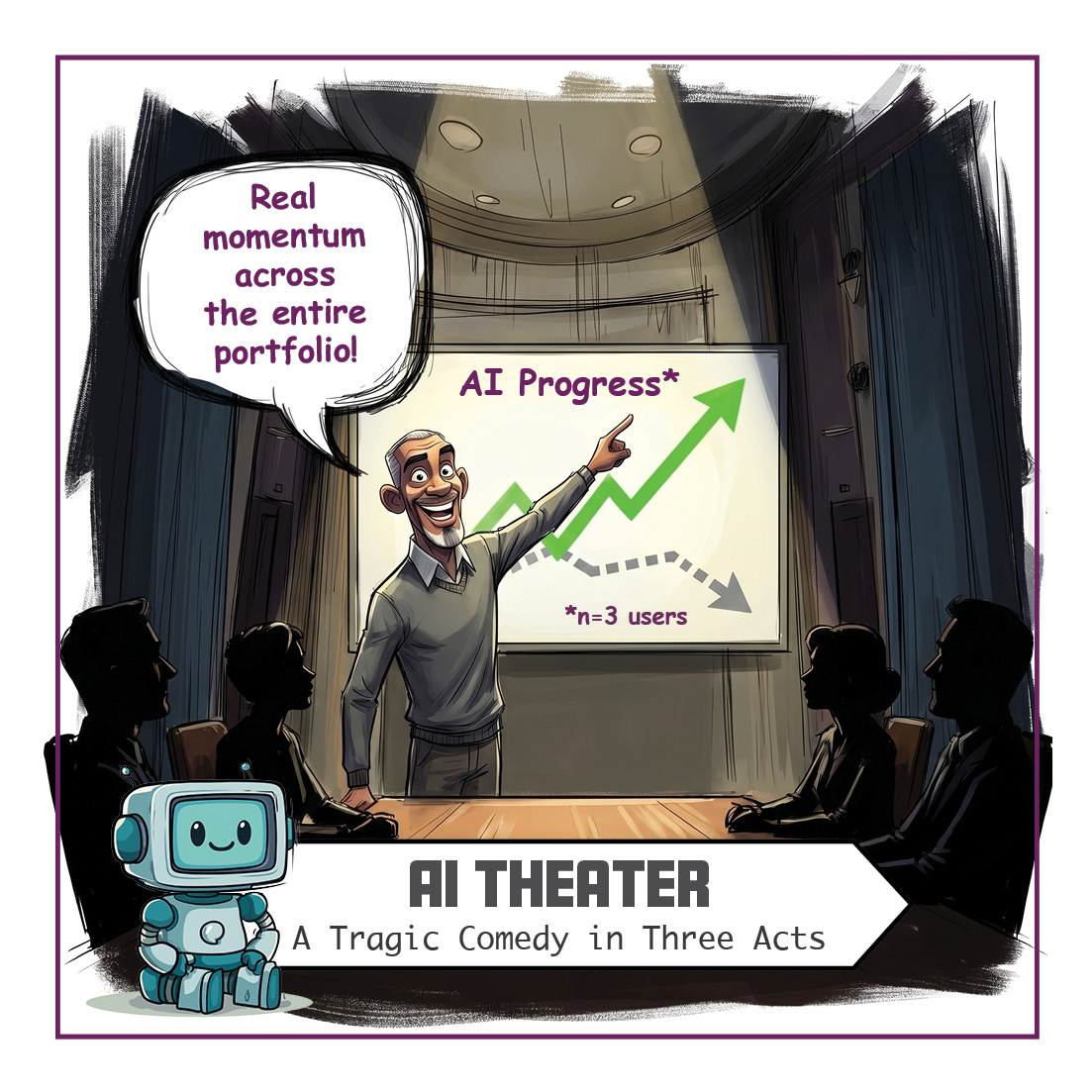
This is what we call AI Theater at POPin. AI Theater is the gap between visible AI activity and provable AI consequence.
Most enterprises now have plenty of AI activity: pilots, demos, dashboards, internal announcements, productivity tools, vendor reviews, steering committees. What many still lack is a decision system for determining which initiatives deserve capital, which deserve to be killed, and which are promising but pointed at the wrong operational target.
That is the uncomfortable part of the “95%” number. It is not just a warning about failed pilots. It is a warning about executive visibility.
If leadership cannot clearly see where AI is changing cost, cycle time, risk, capacity, customer experience, or revenue quality, then the organization is not managing an AI portfolio. It is collecting AI stories.
One of the more interesting findings in the MIT report is that external partnerships with learning-capable, customized tools reached deployment about 67% of the time, compared with about 33% for internally built tools. That should not be oversimplified into “buy beats build.” MIT itself notes important limitations: the results are self-reported, the sample is limited, and the difference may reflect the sophistication of the organizations choosing each path.
Still, the pattern is useful. The higher-performing efforts were not treating AI as a generic capability to install. They were treating it as a workflow problem to solve.
The practical question was not, “Can we build something impressive?”
It was, “Where does work break, who owns that work, what data and feedback does the system need, what decision or action must improve, and how will we know whether the economics changed?”
That is a much higher bar than a pilot.
It is also a much more useful one.
McKinsey’s November 2025 global AI survey reinforces the same gap from a different angle. AI adoption is now widespread: 88% of organizations report regular AI use in at least one business function. But only about one-third say they have begun scaling AI across the enterprise, and only 39% report enterprise-level EBIT impact.
In other words, adoption is no longer the scarce thing. Translation is.
The scarce capability is translating AI from something people try into something the business depends on.
That requires real ownership. Not “the AI team owns AI.” Not “IT owns the platform.” Not “innovation owns the pilot.” Those groups matter, but none of them can substitute for business accountability.
Actual ownership means a business leader is accountable for an operational result, a technology leader is accountable for integration and governance, and finance is involved early enough to define what impact will count before the pilot becomes a narrative exercise.
This is where many enterprise AI programs get into trouble. They are structured to be defensible, not decisive.
They are small enough to avoid risk, broad enough to please stakeholders, generic enough to avoid difficult integration, and vague enough that nobody is accountable when the result is inconclusive.
That may be a comfortable way to run a pilot.
It is not a serious way to create operating leverage.
The companies that get this right will likely run fewer AI pilots, not more. They will choose narrower problems with clearer economics. They will involve the people who own the work, not just the people who own the technology. They will measure against cost, risk, speed, throughput, quality, and revenue impact. They will kill weak initiatives faster. And when something works, they will scale it as an operating change, not celebrate it as a successful experiment.
So yes, we love it when you quote the MIT number. But quote it correctly.
The 95% figure is not a eulogy for enterprise AI. It is an indictment of how enterprises often adopt new technology: too much activity, too little ownership, too many pilots, not enough consequence.
AI did not fail the pilot.
In many cases, the pilot was never designed to produce a business result.
For CEOs, CIOs, and CFOs: where have you seen AI move from interesting activity to actual operating leverage — and what made the difference?
You made it this far because this is your world. Two minutes: find out where AI Theater is hiding in your portfolio →
Book a free 30-minute POPin First Look →